The Adi Parva or The Book of the Beginning is the first of eighteen books of the Mahabharata. "Adi" (आदि, Ādi) is a Sanskrit word that means "first".
Adi Parva traditionally has 19 sub-books and 236 adhyayas (chapters).[1][2] The critical edition of Adi Parva has 19 sub-books and 225 chapters.[3][4]
Adi Parva describes how the epic came to be recited by Ugrasrava Sauti to the assembled rishis at the Naimisha Forest after first having been narrated at the sarpasatra of Janamejaya by Vaishampayana at Taxila. It includes an outline of contents from the eighteen books, along with the book's significance. The history of the Bhāratas and the Bhrigus are described. The main part of the work covers the birth and early life of the princes of the Kuru Kingdom and the persecution of the Pandavas by Dhritarashtra.
Structure & Chapters

The Adi Parva consists of 19 upa-parvas or sub-books (also referred to as little books). Each sub-book is also called a parva and is further subdivided into chapters, for a total of 236 chapters in Adi Parva. The names of 19 sub-books of Adi Parva, along with a brief of each sub-book:
- 1. Anukramanika Parva (Chapter 1)
- Sauti meets the Rishis led by Shaunaka in Naimisha Forest. They express a desire to hear Mahabharata. He explains the stories of creation to them. He narrates the story of how the Mahabharata was written. This parva describes the significance of Mahabharata, claims comprehensive synthesis of all human knowledge, and why it must be studied.
- 2. Sangraha Parva (Chapter 2)
- Story of Samantha Panchaka. Definition of Akshauhini in an army. Outline of contents of 18 books of Mahabharata.
- 3. Paushya Parva (Chapter 3)
- Story of Sarama's curse on Janamejaya, of Aruni, Upamanyu and Veda (The disciples of Sage Dhaumya) and of Uttanka, Paushya and sage Veda.
- 4. Pauloma Parva (Chapters 4 - 12)
- History of the Bhargava race of men. Story of Chyavana's birth.
- 5. Astika Parva (Chapters 13 - 58)
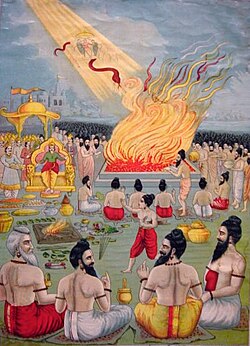
- Story of the Churning of the Ocean. Theories on dharma, worldly bondage and release. Story of the Sarpa Satra including Janamejaya's vow to kill all snakes, step to annihilate them with a sacrificial fire, decision to apply Ahimsa (non-violence) to snakes and all life forms. Story of birth of Astika. Story of how Vaishampayana came to narrate the Mahabharata to Janamejaya.
- 6. Adivansavatarana Parva (Chapters 59 - 64)
- History of Pandava and Kuru princes. Stories of Shantanu, Bhishma and Satyavati. Stories of Karna's birth, Lord Krishna's birth and of and Animandavya. Appeal to Brahma that the gods should reincarnate to save the chaos that earth has become.
- 7. Sambhava Parva (Chapters 65 - 142)
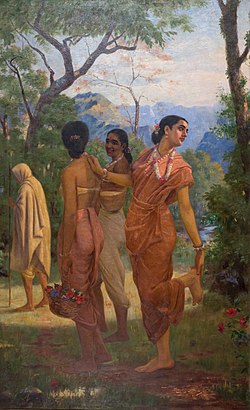
- Theory of life on earth and of gods. Story of Dronacharya, Kripacharya and other sages. Story of Dushyanta and Shakuntala. Story of Bharata's birth. Sakuntala goes to Dushyanta with the boy. He first refuses to remember her and their marriage but later apologizes and accepts. Bharata becomes prince. Stories of Yayati, Devayani and Sharmishtha. Stories of Yadu, Puru and the Paurava race of men. The Pandava brothers retreat into the forest, chased by Dhritarashtra. The stories the Swayamvara of Kunti, marriage of Madri and marriage of Vidura. Attempts to reconcile the conflict between Kauravas and Pandavas.
- 8. Jatugriha-daha Parva (Chapters 143 - 153)
- Kanika counsels Dhritarashtra on how to rule a kingdom and on how deception is an effective tool for governance and war, against enemies and potential competition. Kanika narrates his symbolic tale about jackal, tiger, mouse, mongoose and deer and he advises that a weak ruler should ignore his own weaknesses and focus on other people's weakness and pretend to be friends while being cruel and destructive to others, particularly when the competition is good and stronger. Dhritarashtra schemes to build a home for Pandavas in the forest, from lacquer and other inflammable materials as a friendly gesture, but with plans to burn them alive on the darkest night. Kanika's theory is called wicked and evil by Vidura, a sage of true knowledge and the good, who is also the advisor and friend to Pandavas. Vidura and Pandavas plan escape by building a tunnel inside the inflammable house. The fire is lit and the Pandavas escape. Dhritarashtra falsely believes Pandavas are dead. Duryodhana is pleased and sets on ruling the kingdom.
- 9. Hidimva-vadha Parva (Chapters 154 - 158)
- The story of the wanderings of Pandava brothers after the escape from the fire. Story of Bhima and the Rakshashi Hidimba. She falls in love with Bhima and refuses to help her brother. The story of the battle between Bhima and Hidimba's demon brother, Hidimbasur, showing the enormous strength of the giant brother Bhima. Bhima and Hidimba have a son named Ghatotkacha.
- 10. Vaka-vadha Parva
- The life of Pandavas brothers in Ekachakra. Story about Bhima slaying another demon Bakasura, who has been terrorizing people of Ekachakra. Heroine of Mahabharata, Draupadi, is born in holy fire. Word spreads that the Pandavas may be alive.
- 11. Chaitraratha Parva
- Pandavas set out for Panchala. Story of Tapati and of Vashistha and Vishwamitra. Dehumanization and persecution of Bhargava race of men.
- 12. Swayamvara Parva
- The Pandavas arrive in Panchala. Draupadi's swayamvara. The Pandavas arrive in disguise. Arjuna and Bhima excel in the swayamvara and win Draupadi's heart and hand. The story of her marriage to all the Pandava brothers. Krishna recognizes the individuals in disguise as the Pandava brothers.
- 13. Vaivahika Parva
- Drupada is delighted at discovering that the Pandavas are alive. Her marriage.
- 14. Viduragamana Parva
- Vidura's attempt to reconcile the evil Kaurava brothers and the good Pandava brothers. Various speeches by Karna, Bhishma, Drona and Vidura.
- 15. Rajya-labha Parva
- Pandavas return to Hastinapur with blessings of Krishna. The construction of the city Indraprastha. Story of Sundopasunda (Sunda and Upasunda) and of Narada.
- 16. Arjuna-vanavasa Parva
- Arjuna violates dharma. He accepts voluntary exile. Arjuna marries Ulupi and Chitrangada, and rescues Apsaras. Story highlights his special powers and competence. Arjuna and Krishna become close friends. Arjuna goes to Dwarka, lives with Krishna.
- 17. Subhadra-harana Parva
- Arjuna falls in love with and takes away Subhadra, Krishna's sister. The upset Vrishnis prepare war with Arjuna, but finally desist.
- 18. Harana-harika Parva
- Arjuna returns from exile, with Shubhadra. They marry. Their son Abhimanyu is born. Story of the Upapandavas, the five sons of Draupadi.
- 19. Khandava-daha Parva
- The reign of Yudhishthira - theory and role of effective kings. Stories of Varuna, Agni and Indra. The fight of Krishna (called Achyuta) and Arjuna with celestials, show of their combined abilities and victory.
English Translations
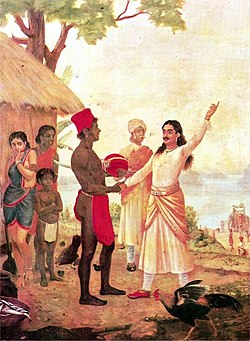
Adi Parva and other books of Mahabharata are written in Sanskrit. Several translations of the Adi Parva are available in English. To translations whose copyrights have expired and which are in public domain, include those by Kisari Mohan Ganguli and Manmatha Nath Dutt.

The translations are not consistent in parts and vary with each translator's interpretations. For example:
Translation by Manmatha Nath Dutt:
Translation by Kisari Mohan Ganguli:
The total number of original verses depend on which Sanskrit source is used, and these do not equal the totalnumber of translated verses in each chapter, in both Ganguli and Dutt translations. Mahabharata, like many ancient Sanskrit texts, was transmitted across generations verbally, a practice that was a source of corruption of its text, deletion of verses as well as the addition of extraneous verses over time. Some of these suspect verses have been identified by change in style and integrity of meter in the verses. The structure, prose, meter and style of translations vary within chapters between the translating authors.
Debroy, in his 2011 overview of Mahabharata, notes that updated critical edition of Adi Parva, with spurious and corrupted text removed, has 19 sub-books, 225 adhyayas (chapters) and 7,205 shlokas (verses).
Controversies
Adi Parva, and Mahabharata in general, has been studied for evidence of caste-based social stratification in ancient India, as well as evidence for a host of theories about Vedic times in India. Such studies have become controversial.
First, the date and authenticity of the verses in Adi Parva, as well as the entire Mahabharata, has been questioned. Klaus Klostermaier, in his review of scholarly studies of Mahabharata, notes the widely held view that original Mahabharata was different from currently circulating versions. For centuries, the Mahabharata's 1, 00, 000 verses—four times the entire Bible and nine times the Iliad and the Odyssey combined—were transmitted verbally across generations, without being written down. This memorization and verbal method of transfer is believed to be a source of text corruption, addition and deletion of verses. Klostermaier notes that the original version of Mahabharata was called Jaya and had about 7000 shlokas or about 7% of current length. Adi Parva, and rest of Mahabharata, underwent at least two major changes - the first change tripled the size of Jaya epic and renamed it as Bharata, while the second change quadrupled the already expanded version. Significant changes to older editions have been traced to the first millennium AD. There are significant differences in Sanskrit manuscripts of the Mahabharata found in different parts of India and manuscripts of the Mahabharata found in other Indian languages such as Tamil, Malayalam, Telugu and others. Numerous spurious additions, interpolations and conflicting verses have been identified, many relating to history and social structure. Thus, it is unclear if the history or social structure of Vedic period or ancient India can be reliably traced from Adi Parva or Mahabharata.
Second, Adi Parva is part of an Epic fiction. Writers, including those such as Shakespeare or Homer, take liberty in developing their characters and plots, they typically represent extremes and they do not truthfully record extant history. Adi Parva has verses with a story of a river fish swallowing a man's semen and giving birth to a human baby after 9 months and many other myths and fictional tales. Adi Parva, like the works of Homer and Shakespeare, is not a record of history.
Third, Adi Parva and other parvas of Mahabharata have been argued, suggests Klaus Klostermaier, as a treatise of symbolism, where each chapter has three different layers of meaning in its verses. The reader is painted a series of pictures through words, presented opposing views to various socio-ethical and moral questions, then left to interpret it on astikadi, manvadi and auparicara levels; in other words, as mundane interesting fiction, or as ethical treatise, or thirdly as transcendental work that draws out the war between the higher and the lower self within each reader. To deduce history of ancient India is one of many discursive choices for the interpreter.
Quotations & Teachings

Anukramanika Parva, Chapter 1:
Sangraha Parva, Chapter 2:
Paushya Parva, Chapter 3:
Adivansabatarana Parva, Chapter 62:
Sambhava Parva, Chapter 73:
Sambhava Parva, Chapter 74:
Sambhava Parva, Chapter 79:
Sambhava Parva, Chapter 133:
Viduragamana Parva, Chapter 206:
| This article uses material from the Wikipedia article Metasyntactic variable, which is released under the Creative Commons Attribution-ShareAlike 3.0 Unported License. |