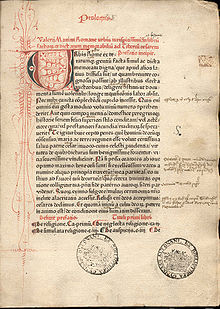
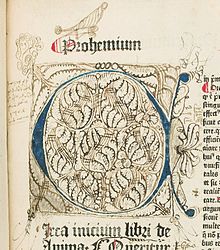
An incunable, or sometimes incunabulum (plural incunables or incunabula, respectively), is a book, pamphlet, or broadside printed in Europe before the 16th century. Incunabula are not manuscripts, which are documents written by hand. As of 2014, there are about 30,000 distinct known incunable editions extant, but the probable number of surviving copies in Germany alone is estimated at around 125,000.[1][2] Through statistical analysis, it is estimated that the number of lost editions is at least 20,000.[3]

Etymology
Incunable is the anglicised form of incunabulum,[4] reconstructed singular of Latin incunabula,[5] which meant "swaddling clothes", or "cradle",[6] and which metaphorically could and can refer to "the earliest stages or first traces in the development of anything".[7] A former term for incunable is fifteener, in the meaning of "fifteenth-century edition".[8]
The term incunabula as a printing term was first used by the Dutch physician and humanist Hadrianus Iunius (Adriaan de Jonghe, 1511–1575) and appears in a passage from his posthumous work (written in 1569): Hadrianus Iunius, Batavia, [...], [Lugduni Batavorum], ex officina Plantiniana, apud Franciscum Raphelengium, 1588, p. 256 l. 3: «inter prima artis [typographicae] incunabula», a term ("the first infancy of printing") to which he arbitrarily set an end of 1500 which still stands as a convention.[9]
Only by a misunderstanding was Bernhard von Mallinckrodt (1591–1664) considered to be the inventor of this meaning of incunabula; the identical passage is found in his Latin pamphlet De ortu ac progressu artis typographicae ("On the rise and progress of the typographic art", Cologne, 1640): Bernardus a Mallinkrot, De ortu ac progressu artis typographicae dissertatio historica, [...], Coloniae Agrippinae, apud Ioannem Kinchium, 1640 (in frontispiece: 1639), p. 29 l. 16: «inter prima artis [typographicae] incunabula», within a long passage of several pages, which he (correctly) quotes entirely in italic characters (that is between quotation marks), referring to the name of author and work cited: «Primus istorum [...] Hadrianus Iunius est, cuius integrum locum, ex Batavia eius, operae pretium est adscribere; [...]. Ita igitur Iunius» (ibid., p. 27 ll. 27–32, followed by the long passage, «Redeo → sordes», ibid., p. 27, l. 32 – p. 33 l. 32 [= Batavia, p. 253 l. 28 – p. 258 l. 21]). So the source is only one, the other is a quotation.[10]
The term incunabula came to denote the printed books themselves in the late 17th century. John Evelyn, in moving the Arundel Manuscripts to the Royal Society in August 1678, remarked of the printed books among the manuscripts: "The printed books, being of the oldest impressions, are not the less valuable; I esteem them almost equal to MSS."[11] The convenient but arbitrarily chosen end date for identifying a printed book as an incunable does not reflect any notable developments in the printing process, and many books printed for a number of years after 1500 continued to be visually indistinguishable from incunables.
"Post-incunable" typically refers to books printed after 1500 up to another arbitrary end date such as 1520 or 1540. From around this period the dating of any edition becomes easier, as the practice of printers including information such as the place and year of printing became more widespread.
Types
There are two types of incunabula in printing: the block book, printed from a single carved or sculpted wooden block for each page, employing the same process as the woodcut in art (these may be called xylographic); and the typographic book, made with individual pieces of cast-metal movable type on a printing press. Many authors reserve the term incunabula for the latter kind only.[12]
The spread of printing to cities both in the north and in Italy ensured that there was great variety in the texts chosen for printing and the styles in which they appeared. Many early typefaces were modelled on local forms of writing or derived from the various European forms of Gothic script, but there were also some derived from documentary scripts (such as most of Caxton's types), and, particularly in Italy, types modelled on handwritten scripts and calligraphy employed by humanists.
Printers congregated in urban centres where there were scholars, ecclesiastics, lawyers, and nobles and professionals who formed their major customer base. Standard works in Latin inherited from the medieval tradition formed the bulk of the earliest printed works, but as books became cheaper, vernacular works (or translations into vernaculars of standard works) began to appear.
Famous examples

The most famous incunabula include two from Mainz, the Gutenberg Bible of 1455 and the Peregrinatio in terram sanctam of 1486, printed and illustrated by Erhard Reuwich; the Nuremberg Chronicle written by Hartmann Schedel and printed by Anton Koberger in 1493; and the Hypnerotomachia Poliphili printed by Aldus Manutius with important illustrations by an unknown artist.
Other printers of incunabula were Günther Zainer of Augsburg, Johannes Mentelin and Heinrich Eggestein of Strasbourg, Heinrich Gran of Haguenau and William Caxton of Bruges and London. The first incunable to have woodcut illustrations was Ulrich Boner's Der Edelstein, printed by Albrecht Pfister in Bamberg in 1461.[13]
Post-incunable
Many incunabula are undated, needing complex bibliographical analysis to place them correctly. The post-incunabula period marks a time of development during which the printed book evolved fully as a mature artefact with a standard format.[14] After c. 1540 books tended to conform to a template that included the author, title-page, date, seller, and place of printing. This makes it much easier to identify any particular edition.[15]
As noted above, the end date for identifying a printed book as an incunable is convenient but was chosen arbitrarily; it does not reflect any notable developments in the printing process around the year 1500. Books printed for a number of years after 1500 continued to look much like incunables, with the notable exception of the small format books printed in italic type introduced by Aldus Manutius in 1501. The term post-incunable is sometimes used to refer to books printed "after 1500—how long after, the experts have not yet agreed."[16] For books printed in the UK, the term generally covers 1501–1520, and for books printed in mainland Europe, 1501–1540.[17]
Statistical data


The data in this section were derived from the Incunabula Short-Title Catalogue (ISTC).[18]
The number of printing towns and cities stands at 282. These are situated in some 18 countries in terms of present-day boundaries. In descending order of the number of editions printed in each, these are: Italy, Germany, France, Netherlands, Switzerland, Spain, Belgium, England, Austria, the Czech Republic, Portugal, Poland, Sweden, Denmark, Turkey, Croatia, Montenegro, and Hungary (see diagram).
The following table shows the 20 main 15th century printing locations; as with all data in this section, exact figures are given, but should be treated as close estimates (the total editions recorded in ISTC at May 2013 is 28,395):
The 18 languages that incunabula are printed in, in descending order, are: Latin, German, Italian, French, Dutch, Spanish, English, Hebrew, Catalan, Czech, Greek, Church Slavonic, Portuguese, Swedish, Breton, Danish, Frisian and Sardinian (see diagram).
Only about one edition in ten (i.e. just over 3,000) has any illustrations, woodcuts or metalcuts.
The "commonest" incunable is Schedel's Nuremberg Chronicle ("Liber Chronicarum") of 1493, with c 1,250 surviving copies (which is also the most heavily illustrated). Many incunabula are unique, but on average about 18 copies survive of each. This makes the Gutenberg Bible, at 48 or 49 known copies, a relatively common (though extremely valuable) edition. Counting extant incunabula is complicated by the fact that most libraries consider a single volume of a multi-volume work as a separate item, as well as fragments or copies lacking more than half the total leaves. A complete incunable may consist of a slip, or up to ten volumes.
In terms of format, the 29,000-odd editions comprise: 2,000 broadsides, 9,000 folios, 15,000 quartos, 3,000 octavos, 18 12mos, 230 16mos, 20 32mos, and 3 64mos.
ISTC at present cites 528 extant copies of books printed by Caxton, which together with 128 fragments makes 656 in total, though many are broadsides or very imperfect (incomplete).
Apart from migration to mainly North American and Japanese universities, there has been little movement of incunabula in the last five centuries. None were printed in the Southern Hemisphere, and the latter appears to possess less than 2,000 copies, about 97.75% remain north of the equator. However many incunabula are sold at auction or through the rare book trade every year.
Major collections
The British Library's Incunabula Short Title Catalogue now records over 29,000 titles, of which around 27,400 are incunabula editions (not all unique works). Studies of incunabula began in the 17th century. Michel Maittaire (1667–1747) and Georg Wolfgang Panzer (1729–1805) arranged printed material chronologically in annals format, and in the first half of the 19th century, Ludwig Hain published, Repertorium bibliographicum— a checklist of incunabula arranged alphabetically by author: "Hain numbers" are still a reference point. Hain was expanded in subsequent editions, by Walter A. Copinger and Dietrich Reichling, but it is being superseded by the authoritative modern listing, a German catalogue, the Gesamtkatalog der Wiegendrucke, which has been under way since 1925 and is still being compiled at the Staatsbibliothek zu Berlin. North American holdings were listed by Frederick R. Goff and a worldwide union catalogue is provided by the Incunabula Short Title Catalogue.[29]
Notable collections, with the approximate numbers of incunabula held, include:
This article uses material from the Wikipedia article
Metasyntactic variable, which is released under the
Creative Commons
Attribution-ShareAlike 3.0 Unported License.
Metasyntactic variable, which is released under the
Creative Commons
Attribution-ShareAlike 3.0 Unported License.